To signal SOS with a flashlight, point it toward rescuers and flash three short bursts, then three longer flashes, followed by three more short bursts. This pattern is the international distress signal in Morse code and is recognized worldwide as a call for help.
The simplicity of this beacon means anyone can learn and use it effectively.
This guide explains emergency flashlight signaling. It covers the history and meaning behind the SOS pattern, the proper techniques, common errors, and other light-based signaling methods.
Understanding the SOS Distress Signal
The SOS signal is the universal distress call, recognized worldwide as a plea for immediate assistance. This three-part sequence follows a specific pattern that stands out from random light flashes.
Meaning of SOS
SOS does not stand for specific words, despite myths like “Save Our Ship” or “Save Our Souls.” The signal was chosen in 1905 because its Morse code pattern is distinctive and easy to recognize.
In Morse code, SOS appears as three dots, three dashes, and three dots (· · · — — — · · ·). When using a flashlight, this means three short flashes, three long flashes, and three short flashes again.
This rhythm stands out from accidental light movements or other signals.
Anyone seeing this pattern should recognize it as an emergency call needing immediate response.
International Emergency Standards
The International Telecommunication Union adopted SOS as the standard maritime distress signal in 1906. This made it legally recognized across all nations and territories.
The signal must follow precise timing to meet international standards.
Short flashes should last about one second, while long flashes last three seconds. Pauses between flashes within a group should match the short flash duration, and groups should be separated by longer pauses of about three seconds.
Executing the SOS Light Signal with Your Flashlight
Signaling SOS with a flashlight means following a pattern of three short flashes, three long flashes, and three short flashes again. The effectiveness of this distress signal depends on proper timing and consistency.
Flashlight Pulse Pattern for SOS
The SOS pattern uses the international Morse code standard. The signal is three short flashes, three long flashes, and three short flashes.
A short flash lasts about one second, and a long flash lasts about three seconds. Keeping this rhythm helps rescuers identify the message.
There should be a brief pause of about one second between each flash in a group. After the full sequence of nine flashes, wait seven to ten seconds before repeating the pattern.
Proper Timing and Intervals
Timing is key for a recognizable distress signal. The standard timing pattern is:
- Short flash: 1 second on
- Long flash: 3 seconds on
- Gap between flashes: 1 second off
- Gap between sequences: 7-10 seconds off
Practice this timing before an emergency to develop muscle memory. Counting slowly, like “one-Mississippi,” helps keep intervals accurate in stressful situations.
Step-by-Step Survival Technique Demonstration
In a survival situation, hold the flashlight steady and point it toward the target area.
Flash three times quickly, counting “one-Mississippi” for each flash with one-second pauses.
Next, make three long flashes, holding each for a count of “one-Mississippi, two-Mississippi, three-Mississippi” with one-second gaps.
Finish with three more quick flashes, then wait seven to ten seconds before repeating the entire pattern continuously until aid arrives—this disciplined repetition is a core survival skill for effective emergency signaling.
Effective Survival Strategies for SOS Flashlight Signals
Making an SOS signal work requires more than just knowing the pattern. Success depends on your position, how visible your light is, and how well you manage your flashlight’s battery.
Optimal Location and Positioning
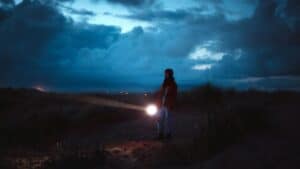
When learning how to signal SOS with a flashlight, the location you choose affects whether rescuers spot you; high ground offers the best vantage point because it increases the distance the light can travel and provides a clear line of sight.
Open areas are better than places surrounded by trees or buildings. Hilltops, clearings, beaches, and open fields let the SOS flashlight signal spread in multiple directions, improving the chance that someone sees you.
If signaling SOS from a vehicle, move away from the car if it is safe to do so. A vehicle’s interior can trap and diffuse the light, making your SOS flashes less bright to rescuers.
Point the flashlight toward the most likely direction of help. If rescue teams may be searching by air, aim the SOS signal upward at about a 45-degree angle rather than straight up to make it easier for aircraft to spot.
Conserving Battery While Signaling
Battery life limits how long you can signal for help. Using the brightest setting drains power quickly, so balance visibility and conservation.
The SOS pattern conserves energy compared to leaving the flashlight on constantly. Flashing extends battery life by three to five times.
Signal in intervals instead of continuously. Flashing for two minutes every ten minutes preserves power while keeping regular visibility for search teams.
Carry spare batteries or a backup flashlight as insurance against power failure. For flashlights that use rechargeable batteries, consider packing a compact power bank in your emergency kit. Survival experts recommend having at least one complete extra set of batteries (disposable or rechargeable) for each flashlight.
Some flashlights, especially modern rechargeable models, have maintained SOS modes that automatically produce the correct pattern. These modes often save power while keeping the signal strong through intelligent power management.
Maximizing Flashlight Visibility
A flashlight’s brightness is vital in emergencies. Models with 200 lumens or more provide good visibility, and higher outputs increase detection range.
White light travels farther through darkness and fog than colored lights, making it best for SOS signals, especially in wilderness settings where long-distance visibility is critical.
Signaling at night or in low-light conditions creates the most contrast against the environment, taking advantage of both the human eye’s dark adaptation and any night vision equipment rescuers may use. During dawn or dusk, signals are harder to see due to ambient light.
Shielding the light with your body between flashes creates clear on-off patterns that catch attention better than continuous waving.
Multiple flashlights increase the chance of detection. If several people have flashlights, they should spread out and signal together to create a larger visible area, a highly effective tactic in open wilderness.
Common Mistakes to Avoid
Even experienced outdoor enthusiasts can make mistakes when signaling for help. Proper timing, clear line of sight, and accurate patterns make the difference between effective signals and those that go unnoticed.
Obstructed Light Beams
Trees, rocks, and terrain can block a flashlight beam. Find the highest point nearby to maximize visibility range.
Common obstructions include:
- Dense foliage and branches
- Rocky outcroppings
- Hillsides and ridges
- Building structures
- Vehicle bodies
Sweep the flashlight in a slow arc across the horizon instead of pointing it in one direction. This ensures the SOS pattern reaches more search areas.
Pointing the light at the ground or obstacles wastes battery power and reduces rescue chances.
Irregular Signal Timing
The SOS pattern depends on precise timing.
Three short flashes should last about one second each, while three long flashes should be about three seconds each. Consistency is important. Each repetition of the SOS sequence should keep the same rhythm and spacing.
Varying the timing can make rescuers think the signal is just routine flashlight use. Pauses between signal groups matter. A two to three second gap should separate the short flashes from the long flashes, and another pause should come before the final three short flashes.
Alternative Light Sources for Distress Signals
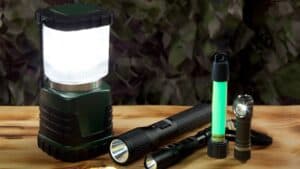
If a traditional flashlight is not available, headlamps and lanterns can also transmit SOS signals. Improvised light sources like phone screens and glow sticks can serve as backup options in emergencies.
Using Headlamps or Lanterns
Headlamps are useful for signaling because they are hands-free. The wearer should remove the headlamp and hold it at arm’s length, pointing it toward potential rescuers while flashing three short bursts, three long bursts, and three short bursts again.
Many modern headlamps include built-in strobe or SOS modes. These modes automatically transmit the correct pattern.
Lanterns provide broader light distribution than directional beams. This makes them visible from multiple angles at once.
A person can signal with a lantern by placing an opaque object in front of it to block the light, then removing it in the SOS rhythm. This method works best with LED lanterns because they respond instantly to being turned on and off.
Headlamps typically consume less power than lanterns. They often last 8-12 hours in flash mode, while lanterns may last 4-6 hours of continuous use.
Improvising With Other Rechargeable Light Sources
Smartphone flashlights serve as reliable emergency signals when dedicated lighting fails. Most phones allow rapid toggling of the camera flash through quick settings or dedicated apps.
Battery drain occurs faster than standard flashlight operation. Users should reduce screen brightness to extend battery life while signaling.
Vehicle headlights and taillights generate powerful signals visible for miles in darkness. A person can flash high beams or use hazard lights modified into the SOS pattern by turning the vehicle’s electrical system on and off.
This method drains car batteries within 30-45 minutes, so it should be reserved for when rescue seems imminent.
Chemical light sticks and road flares create sustained illumination rather than precise flashing patterns. Someone can wave these light sources in the SOS rhythm or arrange multiple units in patterns that spell “SOS” on the ground.
Why choose M&F Optoelectronics flashlights?
With over 15 years of experience in portable lighting, M&F Optoelectronics offers a diverse range of lighting solutions. We pride ourselves on providing solutions that you can trust and rely on, supporting you through every step: selection, design, manufacturing, delivery, warranty, and more.
The key features of M&F Optoelectronics flashlights
- Competitive Pricing: We offer competitive pricing for our high-quality portable lighting solutions. While not aiming to be the absolute cheapest, M&F ensures fair pricing, delivering added value through product reliability and suitability for various applications .
- R&D Capability: Our in-house product designers have been transforming concepts into new designs since 2017. We can produce a design sketch within 3 days and a 3D-printed prototype with working functions within 7 days. All unique OEM models are patented .
- Quality Assurance: Consistent quality is our core commitment. We enforce strict quality control at each product stage and conduct final QC inspections for all orders. Additionally, we offer a 12-month free warranty .
- One-Stop Problem Solvers: Our streamlined team structure allows for efficient communication and problem-solving. With over 10 years of experience in the lighting industry, our sales team provides expert guidance to ensure a smooth purchasing process .
Our flashlights are suitable for various applications, including outdoor recreation, emergency preparedness, law enforcement, and home maintenance . We also offer OEM and customization services to meet your specific needs .
Discover more about our range of portable lighting products and how we can be your trusted supply partner. Contact Us for free quote.