
A buyer sends us a comparison sheet containing quotations from several LED flashlight manufacturers. The housings look similar. The listed brightness is similar. Every model uses USB-C charging, and most of the suppliers describe their products as water-resistant.
The prices are not similar.
The usual question is: why does one flashlight cost 10% or 20% more when the specification sheets appear to describe the same product?
In many cases, they do not describe the same product at all. They use the same vocabulary.
One supplier may quote the rated output of the LED rather than the measured output of the complete flashlight. Another may calculate runtime after the brightness has already dropped. Two batteries can carry the same capacity marking while differing in discharge stability, cycle life and batch consistency.
This is why an LED flashlight manufacturer evaluation should not begin and end with a price sheet. The buyer first needs to establish whether the quotations are technically comparable.
MFOPTO has worked with importers, distributors, retailers and private-label lighting buyers since 2011. We manufacture and develop wholesale LED flashlights as part of a broader portable-lighting range. From that experience, the most expensive sourcing problems usually begin with details that were never properly defined before the order was placed.
The Quotation Is Not the Product
A quotation normally shows information that is easy to compare: lumen output, battery capacity, product size, material, charging method and unit price. It may not explain how those figures were obtained.
Consider a flashlight described as “1,000 lumens.” That figure could refer to the theoretical output of the LED component, the output measured immediately after switch-on, or the measured output of the complete flashlight after optical and electrical losses. Those are different values.
Runtime can be just as ambiguous. A supplier may state four hours without explaining the mode, current setting or cut-off point used for the test. The product may begin at high output and then reduce power to control heat or conserve battery capacity.
That step-down behaviour is not automatically a defect. It is common in rechargeable lighting. The important question is whether the output and runtime were measured and described consistently.
Buyers who need a more structured way to read performance claims can review our explanation of ANSI FL1 flashlight measurement categories. Output, runtime, beam distance and water resistance should not be treated as interchangeable marketing numbers.
A Useful Enquiry Starts with the Application
We regularly receive requests for our “best flashlight” or “most competitive model.” Neither description is specific enough to prepare a useful recommendation.
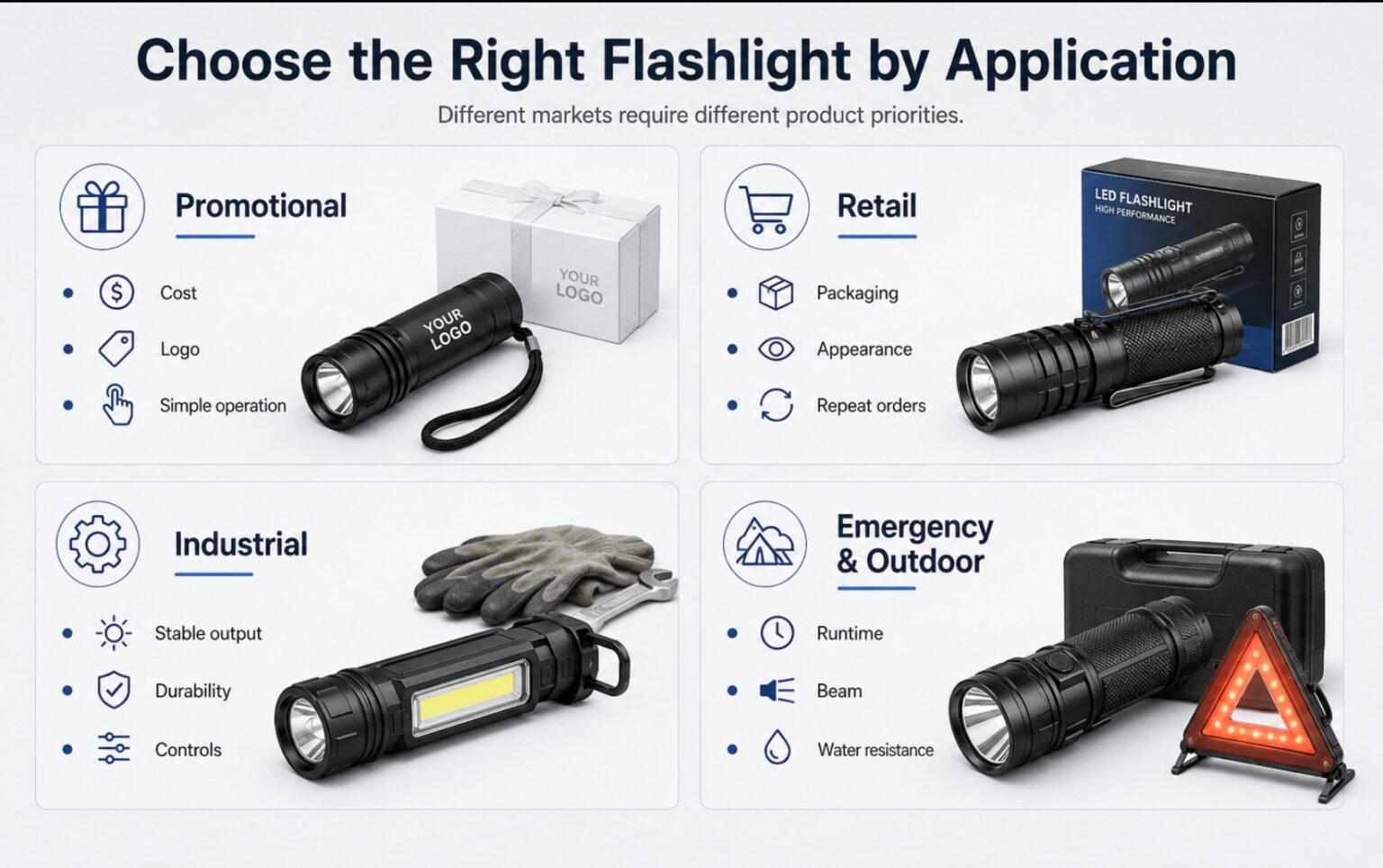
A promotional flashlight, an industrial inspection tool and an emergency light may all use LEDs and batteries, but they do not require the same product configuration.
A promotional buyer may accept a simpler battery and packaging structure in order to reach a target price. An industrial buyer may care more about stable output, switch durability and hands-free mounting. A retailer may prioritise appearance, shelf packaging, barcode requirements and repeat-order consistency.
Before an OEM flashlight manufacturer recommends a model, it should understand where the product will be sold, how it will be used, the likely order quantity, the required packaging and which performance claims matter commercially.
Brightness is a good example. A buyer may initially request the highest possible lumen figure. After discussing the use case, it may become clear that a wider beam, simpler operation or longer stable runtime is more useful. The difference between spot, flood and mixed beams is explained in our guide to flashlight beam types.
A capable LED flashlight supplier does not automatically recommend the highest-output model in its catalogue. It asks enough questions to understand which compromises are acceptable.
Where the Price Difference Usually Comes From
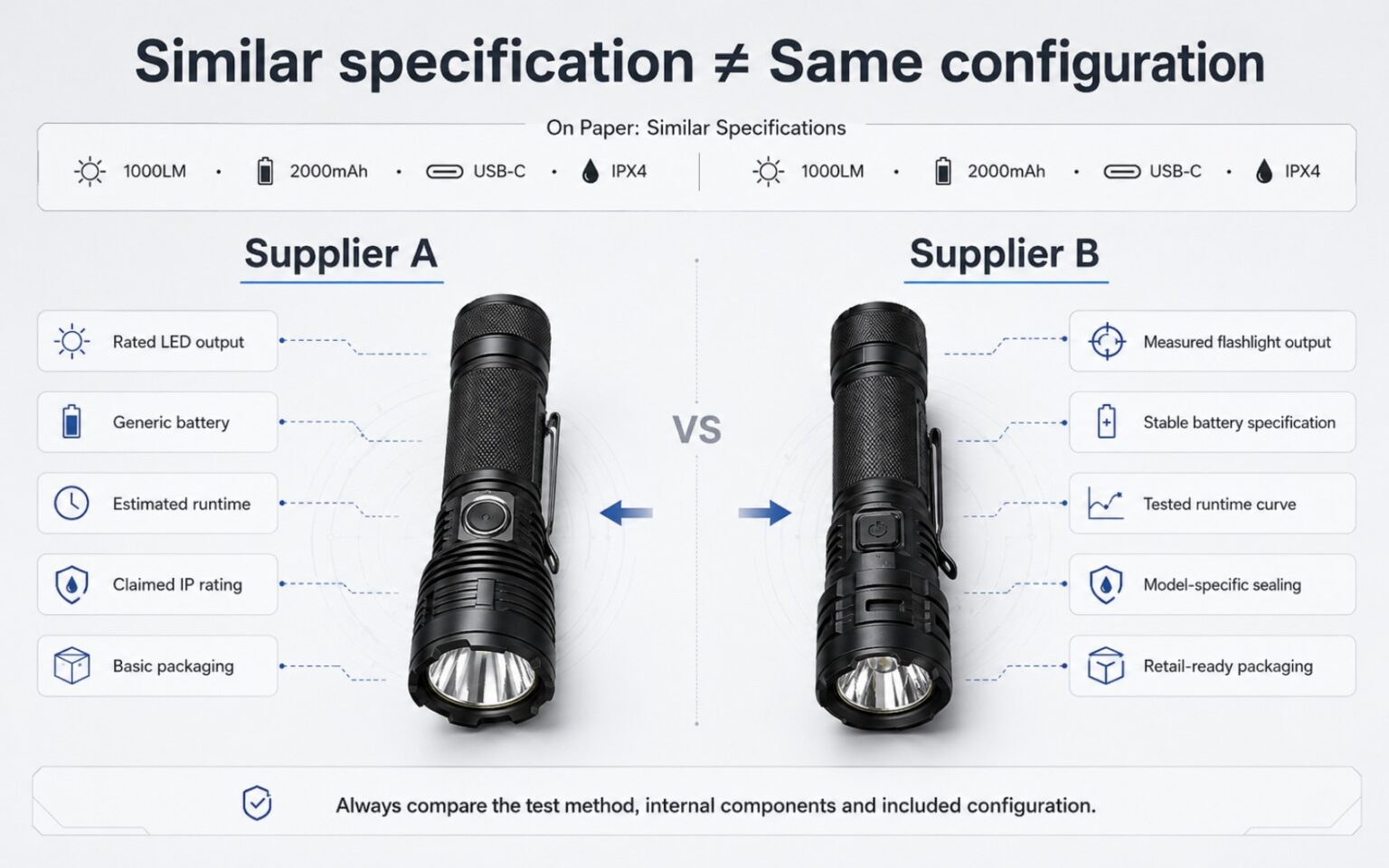
The visible housing is only one part of a flashlight. Meaningful cost differences are often found in the battery, driver, sealing structure, small electrical contacts, assembly process, packaging and testing requirements.
Battery Configuration
The battery is one of the largest cost and quality variables in a rechargeable flashlight. A lower-cost cell may be perfectly suitable for a simple promotional product. It may be a poor fit for a model expected to support high current, repeated charging or long storage.
The problem is not the existence of different battery grades. Different markets require different configurations. The problem begins when the battery specification is vague, or when the approved sample and the mass-production order do not use the same cell.
For a rechargeable flashlight project, the specification should identify the cell type, rated voltage, nominal capacity, number of cells, protection arrangement and charging method. It should also state whether the battery is built in or replaceable.
Buyers comparing rechargeable and replaceable-battery flashlights should consider storage, local battery availability, transport, output requirements and the expected retail price—not just convenience.
For lithium-powered products, changing the cell or battery pack can also affect transport documentation. The applicable battery configuration should be reviewed against the UN Manual of Tests and Criteria, subsection 38.3, rather than assuming that one document covers every rechargeable product.
Driver and Sustained Output
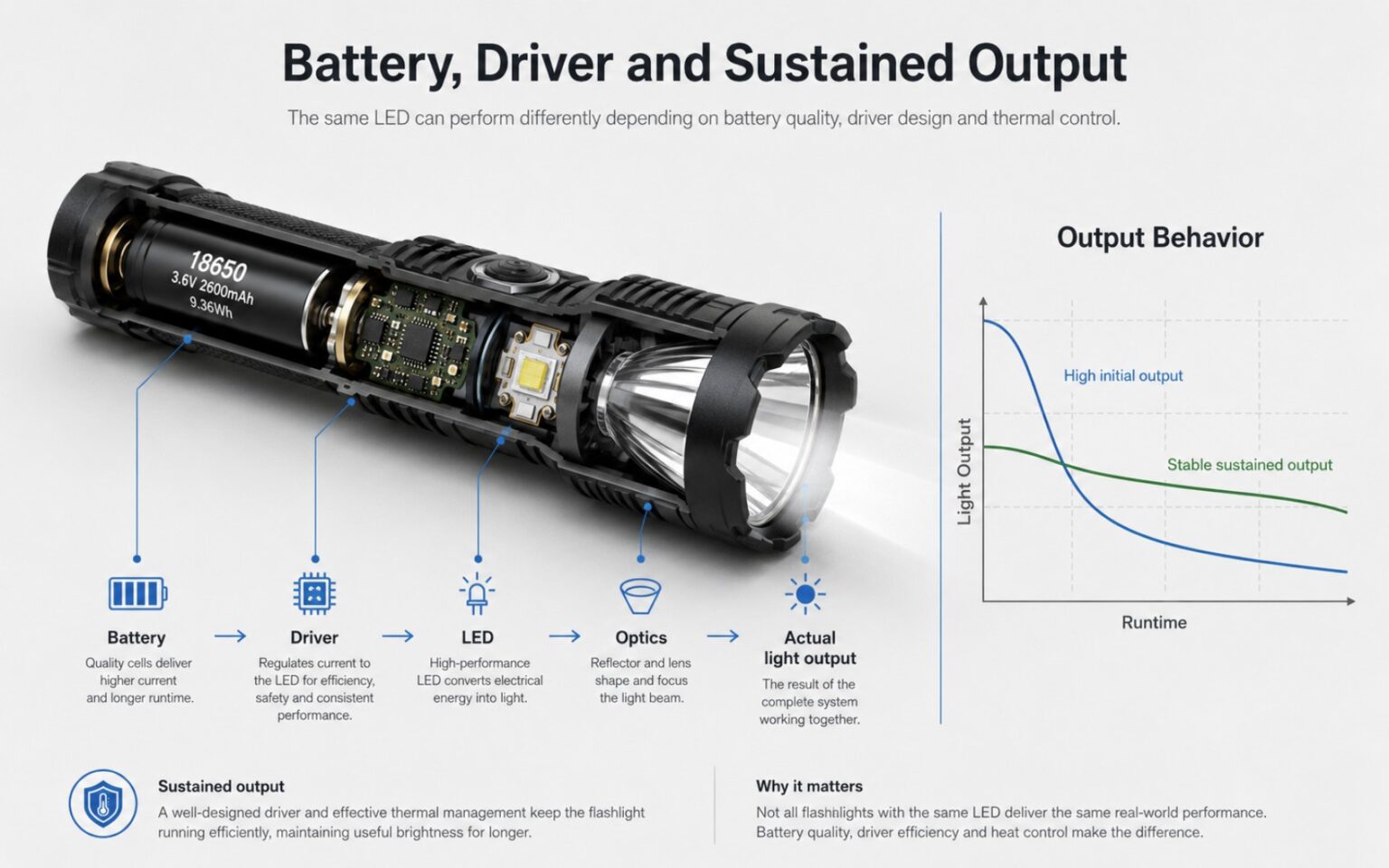
Two products using the same LED can behave differently because of the current setting, circuit efficiency, thermal control and operating sequence.
Increasing current can raise initial brightness, but it also creates more heat and consumes energy faster. For some retail products, a powerful short-term high mode is useful. For inspection or work applications, stable output may matter more.
Neither design choice is universally correct. The flashlight factory should be able to explain which approach the product uses and what happens as the product warms up.
Our article on LED driver selection and function provides additional background on why the circuit matters. “High-power LED with long runtime” is not a meaningful technical explanation unless the operating conditions are also defined.
Housing, Sealing and IP Claims
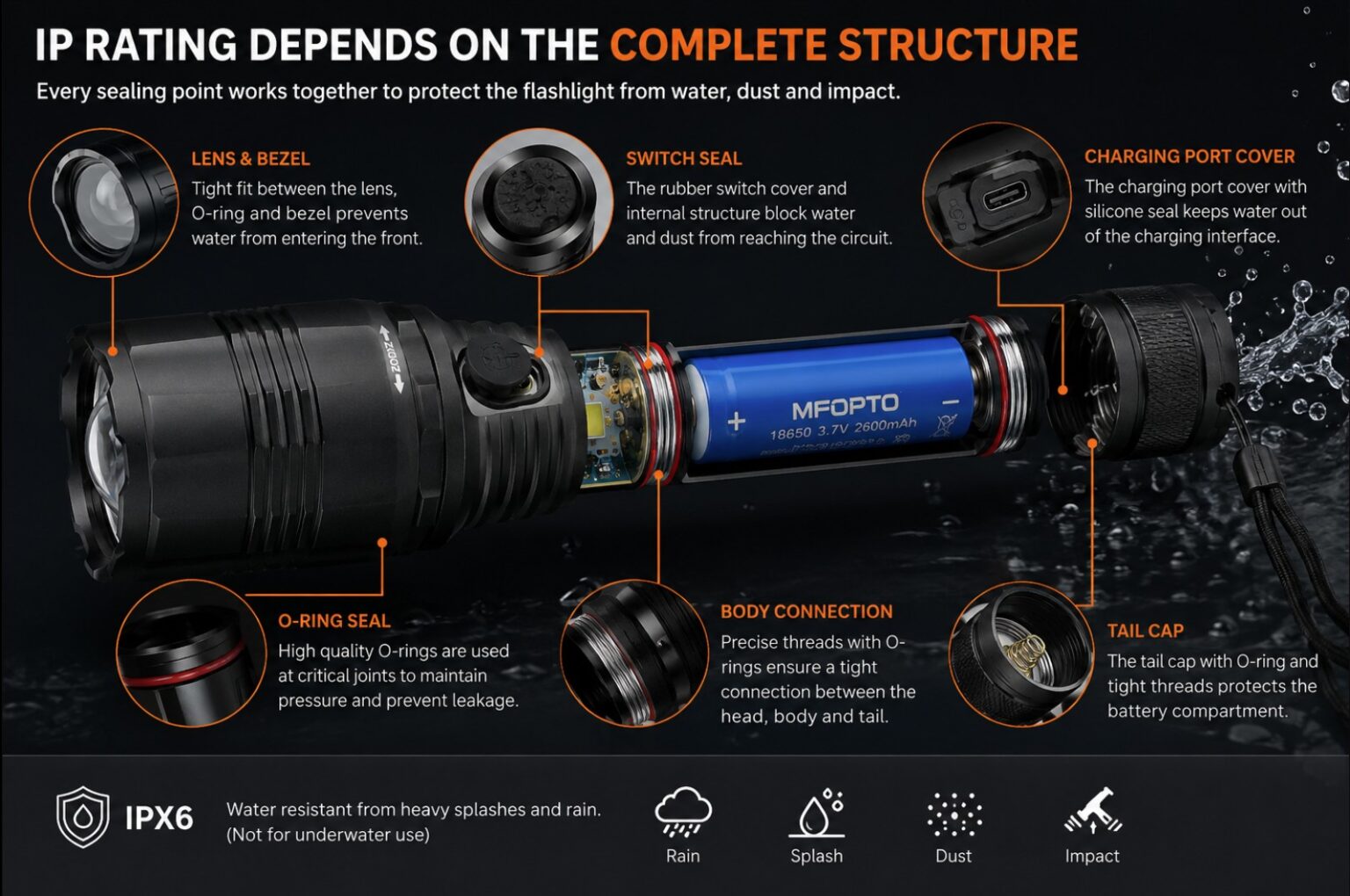
Water resistance is not created by adding an IP claim to a quotation.
It depends on the lens joint, O-rings, switch structure, charging-port cover, housing interfaces, screws, assembly pressure and production tolerances. Two flashlights that look almost identical can produce different test results.
IEC 60529 defines the IP classification system for enclosure protection. When water resistance is important to the project, the supplier should connect the claim to the actual model and configuration being purchased.
Changing the charging port, housing joint or assembly method may affect the result. We would therefore be cautious about a supplier that describes almost every model as IP67 without discussing its structure or model-specific evidence.
Small Parts and Packaging
Buyers naturally focus on the LED, battery and main housing. Smaller components can still determine whether a product remains reliable after repeated use.
Switch contacts, springs, charging-port components, clips, magnets, rubber covers and screws may not attract attention during a short sample inspection. Weaknesses can appear later as unstable charging, poor contact, loose accessories or inconsistent switching.
Packaging creates another comparison problem. One quotation may include only the flashlight and charging cable. Another may include a printed colour box, tray, manual, barcode label and retail-ready export carton.
A lower unit price is not necessarily a lower total cost. The quotation needs to state what is included.
A Good Sample Does Not Guarantee Good Mass Production
A sample can be assembled carefully by an experienced technician. Mass production uses larger material batches, repeated processes and more operators. The real question is whether the factory can reproduce the approved sample consistently.
Before production, the parties should fix the important configuration through the approved sample, specification sheet, packaging artwork and order documents. Depending on the project, this may cover the LED, operating modes, battery, charging method, housing material, colour, logo, accessories and packaging.
A manufacturer should not silently replace a major component after sample approval.
Substitutions are sometimes unavoidable. A component may be discontinued or delayed by an upstream supplier. In that situation, the correct process is to identify the proposed change, explain its effect and obtain approval before continuing.
The problem is not always the substitution itself. The problem is an uncontrolled substitution.
For a closer look at the sequence from component installation through final assembly and sealing, see how LED flashlights are produced. Production-process transparency is more useful than a collection of generic factory photographs.
What We Would Not Confirm Without Evidence
We would not confirm a waterproof rating because another product uses a similar housing. Small structural differences can change sealing performance.
We would not present the rated output of an LED component as the guaranteed output of the complete flashlight. The driver, lens, reflector, temperature and power source all affect the result.
We would not assume that one battery document covers every cell or battery-pack configuration. A change in the cell, protection circuit or pack construction may require another review.
We would not describe basic logo printing as complete ODM development. Printing, packaging customisation, functional modification and new tooling are different levels of work.
We would not promise a very low MOQ for a customised product without checking the production process. Printing, packaging, material purchasing and machine setup may each have their own minimum quantity.
We would not promise maximum brightness, maximum runtime, the smallest housing and the lowest price at the same time. Portable-lighting design involves trade-offs.
A supplier gains credibility by explaining what it cannot responsibly promise. Immediate agreement is not always a sign of strong service. Sometimes it means that the technical consequences have not yet been considered.
How to Build a Supplier Shortlist That Matches the Project
There is no universal list of the best LED flashlight manufacturers. An established consumer brand, an OEM factory and a trading company can all be competent suppliers, but they solve different purchasing problems.
Our existing LED flashlight manufacturer market overview is useful for identifying recognised brands and product-positioning references. A sourcing shortlist needs an additional filter: whether the company actually supports the buyer’s order model.
| Purchasing requirement | Supplier type to prioritise | What to verify |
|---|---|---|
| Existing product with private-label packaging | Private label flashlight manufacturer or OEM factory | Standard model history, branding MOQ, packaging options and available reports |
| Functional or structural modification | Custom flashlight manufacturer with engineering access | Prototyping, tooling, circuit changes, updated testing and development ownership |
| Small mixed order across several categories | Trading company or broad portable-lighting supplier | Production source, inspection responsibility and repeat-order consistency |
| Large retail programme | Manufacturer with project and supply-chain management | Packaging development, retailer testing, inspection standards and delivery scheduling |
| Finished branded products for distribution | Established flashlight brand | Distribution rights, territory, warranty process and channel policy |
A long supplier list is useful during initial research. It should become shorter after technical communication and sample review.
Remove suppliers that cannot identify the quoted battery, explain output behaviour or confirm what is included in the price. After samples arrive, compare charging behaviour, heat, beam shape, switching consistency, housing fit and packaging—not just which product appears brightest during the first minute.
The final shortlist should contain suppliers that can repeat the required configuration. It should not simply contain the lowest quotations.
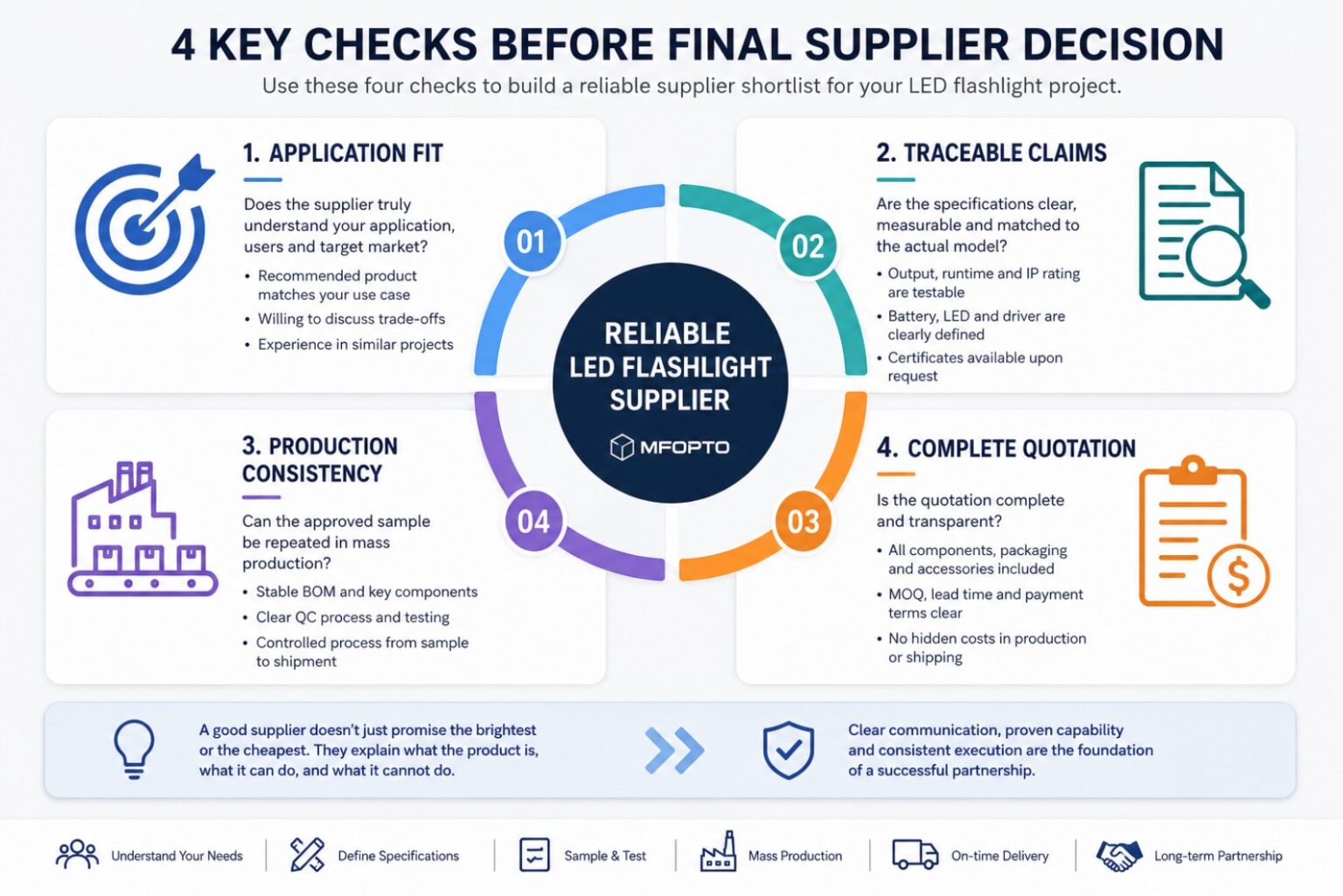
Four Checks Before the Final Supplier Decision
- Does the supplier understand the application?
- A supplier that understands the use case can recommend sensible compromises instead of pushing the closest catalogue item.
- Are the product claims traceable?
- The output, battery, material and IP claim should relate to the actual quoted model—not a similar product or a component-level specification.
- Can the approved sample be repeated?
- The manufacturer needs a practical method for controlling key parts and approved details during mass production.
- Is the quotation commercially complete?
- The buyer should know what is included, what requires separate payment and what changes when quantity, packaging or customisation changes.
These four checks are more useful than a supplier presentation filled with broad claims about quality, service and competitive pricing.
MFOPTO’s View as an LED Flashlight Manufacturer
MFOPTO manufactures and develops flashlights, work lights, headlamps, camping lights and safety lighting products. More information about our history, product development and service model is available on the MFOPTO company page.
We support existing-product orders as well as OEM and ODM projects. We do not believe that every enquiry should become a new tooling project.
Sometimes the practical solution is an existing flashlight with different packaging, another battery configuration or a revised operating sequence. In other cases, the requirement cannot be achieved reliably within the target size, price or order quantity.
Our role as a China LED flashlight manufacturer is not only to submit a unit price. It is also to explain which parts of the specification are realistic, which choices create cost and which modifications may affect testing or production.
Buyers who are still defining their range can review the MFOPTO product catalogue. For a model recommendation or an OEM project review, send the intended application, target market, quantity, packaging requirement and target price through our lighting project enquiry form.
Conclusion
Evaluating an LED flashlight manufacturer requires more than comparing company profiles, product photographs and headline specifications.
The useful questions sit behind the quotation:
- How was the output defined?
- Which battery is actually being used?
- What happens when the flashlight becomes hot?
- Does the water-resistance claim apply to this exact model?
- Will production use the same components as the approved sample?
- Does the price include the complete required configuration?
A reliable LED flashlight supplier does not need to claim that every model is the brightest, strongest or cheapest. It needs to explain what the product is, what it can do and where its limitations are.
That is the basis of a useful supplier shortlist—and usually the beginning of a more stable purchasing project.